
Buying Guides
3D Printers and Printer Parts from China: A Sourcing Guide
Consumer 3D printers, spare parts and filament from Chinese suppliers: how the category splits, what a bench test reveals, and how an agent keeps an electronics order honest.
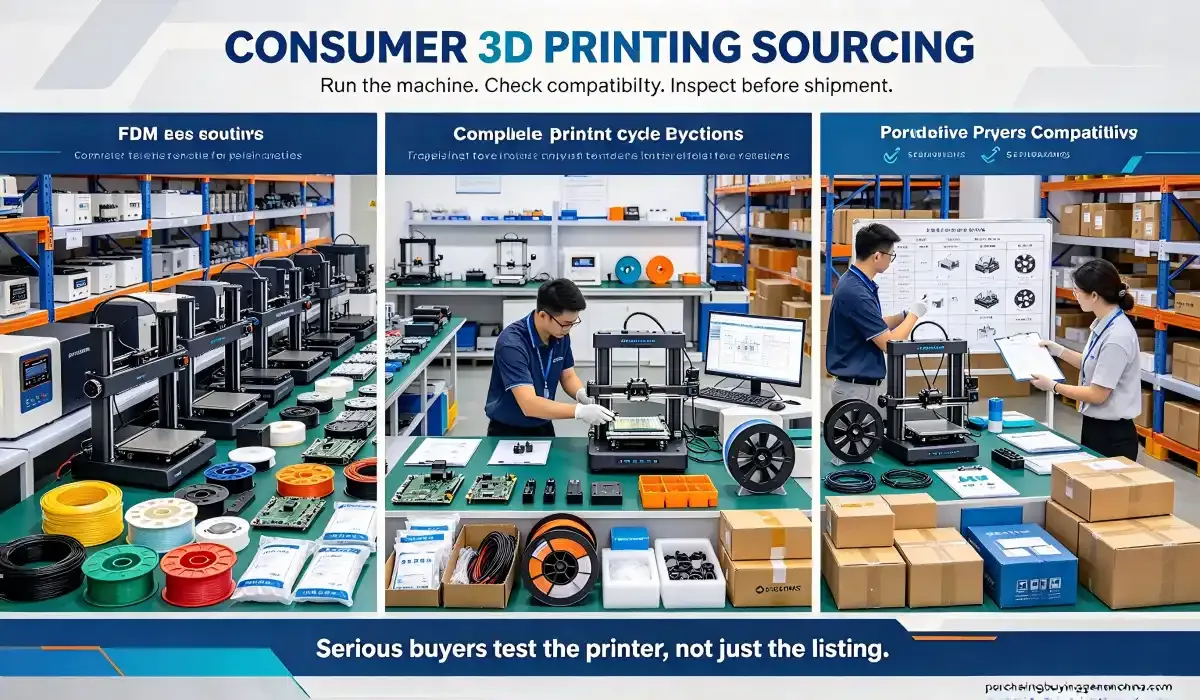
Consumer 3D printing is one of the categories where China is not just a supplier but the center of the industry. The machines that filled the market over the last few years were designed and built in the southern factory belt, and the ecosystem around them - nozzles, boards, belts, beds, hotends, filament - sits in the same neighborhoods. For a buyer, that density is the opportunity: nearly every part of a printer can be sourced within a short drive of the port.
The category splits into three very different shopping lists. Whole machines - the FDM printers most resellers and education buyers want, plus their resin cousins. Spare parts - hotends, extruders, mainboards, cables, beds, belts, fans - the long tail that printer owners keep buying. And consumables - filament spools in every color and material, the subscription-like repeat purchase that keeps customers coming back.
Whole machines: what a bench run reveals
A printer is judged by running it, not by looking at it. The checks that matter are the ones a supplier's listing will never show: does the machine complete a full print without wandering; do the layers come off the bed cleanly; does the frame stay square after a week of cycles; does the screen, the bed level sensor and the filament sensor all behave. This is why serious buyers insist on a burn-in run - machines run in the warehouse for a real print cycle before shipping, not just powered on.
Packing is the second half of machine quality. A printer that survives the factory and not the freight is a refund waiting to happen, and the difference is foam placement and a box that was designed with the machine in it.
Parts and filament: the long tail
Spare parts look simple and are not - the trap is compatibility. A hotend that fits one brand's mount does not fit another's; a board version differs within a single model year. The buyers who do well here keep a compatibility sheet - model, version, connector - and expect the supplier to confirm against it, not against a photo. Filament asks about tolerance and packing: consistent diameter, spools wound cleanly, and sealed with desiccant, because filament that arrives wet prints badly and gets blamed on the printer.
Electronics and Smart Devices: Buying from ChinaHow the buying runs with an agent
Printers, parts and filament are among the categories we handle for our customers. Send your list - machines with the specs you want, parts with the models they must fit, or a filament program with colors and materials. We shortlist factories, gather quotations, and get samples or demo units back to you. Machines are bench-run before shipment; parts are checked against the compatibility list; filament batches are checked for packing and consistency. And because printer orders mix big boxes with small heavy parts, we consolidate the whole order into shipments that make freight sense.
Our Electronics and Smart Devices Purchasing ServiceWho this category suits
Electronics retailers adding printers and parts to their shelves. Education suppliers fitting out classrooms and labs. Online sellers building a spares business on the long tail. Whoever you are, the first step is the list - and the second is making sure someone runs the machines before they get on a boat.
Send us your printer and parts list and we will start the factory shortlist