
Buying Guides
Alibaba vs. 1688: Same Group, Totally Different Platforms
They share a parent company and a logo color, but Alibaba and 1688 are built for different buyers. What actually separates them, and how to use both.
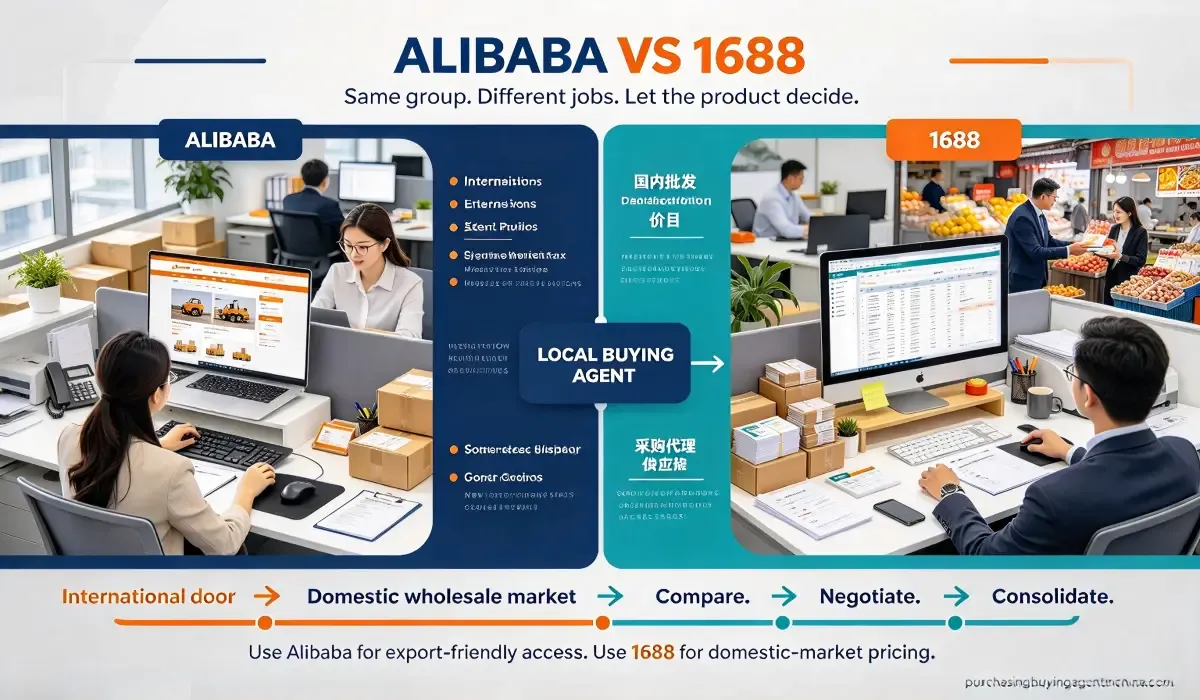
The most common misunderstanding in China sourcing is treating Alibaba and 1688 as two versions of the same store. They belong to the same group and share the same orange, and that is roughly where the similarity ends. One is built to sell Chinese goods to the world; the other is built to sell Chinese goods to China. Knowing which is which - and when to use each - is worth real money on every order.
Who each platform is built for
Alibaba is the international storefront. English interface, overseas-friendly checkout, sellers who are used to quoting in dollars and shipping across borders. It is where a first-time importer can go from browsing to ordering without help, and its seller base ranges from genuine factories to trading companies of every size.
1688 is the domestic wholesale market. Chinese language, Chinese accounts, Chinese payment habits, sellers who may never have shipped abroad. What it offers in exchange for that friction is reach: the wholesale market Chinese buyers themselves shop in, including many factories and market stalls that never list on the international site. Prices on 1688 often run below the same goods quoted on Alibaba - not because Alibaba sellers are greedy, but because the two sites serve different cost structures and different buyer expectations.
How the listings differ
On Alibaba, expect polished listings: English specs, minimum orders stated up front, export-experienced sales staff who reply in your working hours. On 1688, expect the domestic reality: listings in Chinese, minimums and price tiers aimed at local resellers, and sellers who move fast when asked a direct question by someone who sounds local - and slowly, or never, when asked by someone who does not. That asymmetry is the single best argument for working with someone on the ground.
When to use which
Use Alibaba when you are starting, when the order is your first with a product, or when you need the comfort of export-experienced sellers. Use 1688 when the product is standard, the volume justifies it, or when you want to know what local buyers really pay - which is itself negotiating information. Many steady importers end up doing both: Alibaba for new or complex items, 1688 for the repeat lines where the price gap compounds.
How to Source Products from 1688: A Step-by-Step GuideThe access problem, solved
The honest friction of 1688 is access: the site, the account, the payment habits, the conversations. All of it dissolves in front of a buying agent. You send the product list; we quote it on both platforms at once, talk to 1688 sellers in their own language and working rhythm, compare what comes back, and consolidate the winners into one shipment. You get the domestic market's prices without needing to speak a word of Chinese.
Our 1688 and Taobao Purchasing Agent ServiceThe bottom line
Same group, different jobs. Alibaba is the door with the welcome mat for overseas buyers; 1688 is the market behind it, where the prices live. The buyers who do best are rarely loyal to either - they let the product decide, and they have someone local doing the asking.
Send us your list and see both platforms compared on one quote