
Buying Guides
Apparel and Clothing to Source from China: A Product Guide for Small Wholesalers
What clothing categories China's wholesale market offers, the garment details to settle before you pay, and how a buying agent handles a mixed apparel order.
Why apparel is where most small wholesalers start
Clothing is the category most first-time China buyers begin with, and for good reasons: the range is enormous, styles follow retail trends closely, and nearly everything can be ordered in small mixed lots rather than full container loads. A shop owner can test ten styles in a handful of sizes, see what moves, and reorder the winners - something the factory-direct export model, with its style minimums, was never designed for.
Apparel is also a category where the local market and the export market are different worlds. 1688 and the wholesale markets exist to serve domestic Chinese sellers: listings are in Chinese, prices are per-piece in yuan and often tied to quantity breaks, and sellers ship inside mainland China. Overseas buyers usually cannot even register for some seller tiers, let alone negotiate. That is the gap a buying agent fills - the market itself is open to anyone who can operate inside it.
The clothing range you can order through a buying agent
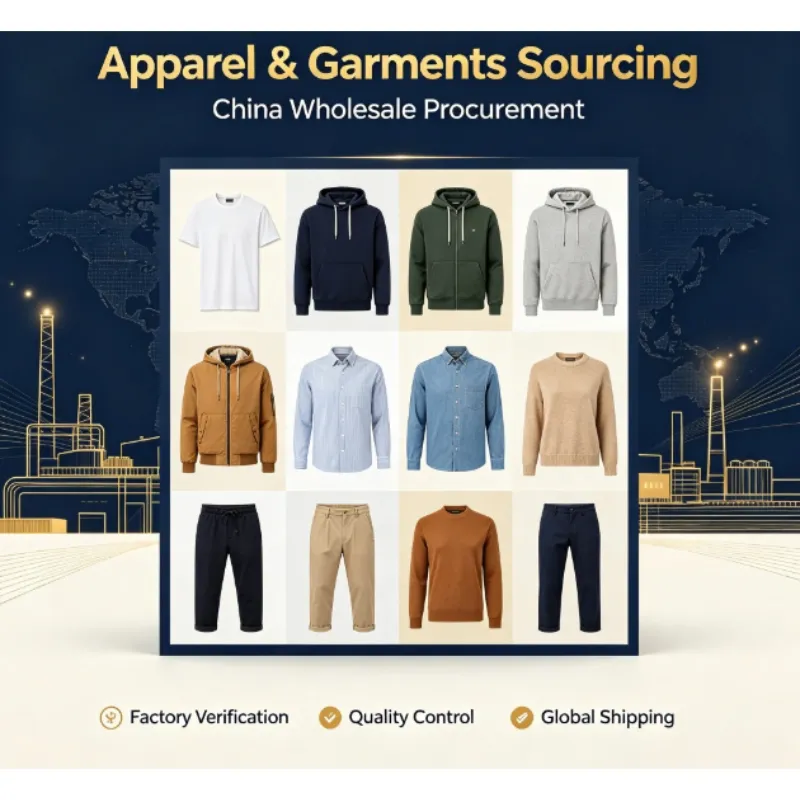
A buying agent does not carry a fixed catalog - the range is whatever China's clothing market currently makes. To give an idea of the breadth, our own apparel sourcing service covers families like casual wear (T-shirts, hoodies, jackets, coats and sweaters), autumn and winter thermal garments and layered outfits, tailored suits and classic outerwear, vintage and retro color-matched styles, Christmas-themed sweaters and family matching outfits, festival dresses and printed festive apparel, luxury textures such as velvet, charmeuse, shearling and leather styles, street fashion and sports casual wear, business casual and commuter outfits, and custom uniform or brand-customized clothing.
Two things are worth noticing in that list. First, seasonal and holiday apparel sits next to year-round basics - the same agent order can carry both. Second, "custom" appears more than once: custom holiday clothing for seasonal retail promotion and brand-customized series are standard requests, not special cases, because the suppliers behind these listings expect to work from a buyer's reference.
China wholesale clothing procurement and 1688 sourcingFabric, sizing and labelling details to settle before you pay
Clothing orders fail on details that never appear in product photos. The three that matter most are sizing standards, fabric requirements and order volume - and those flow from you to the supplier, not the other way around. Chinese domestic sizing runs smaller than US or EU sizing in many styles, so "L" on a 1688 listing is not the "L" your customers know. Send a size chart, or ask for the actual garment measurements of each size in centimeters.
Fabric needs to be named, not implied. The same style can be made in a dozen fabrics at a dozen prices, and a listing photo does not tell you which one you will get. State the fabric and weight you expect, or ask the supplier to confirm what the sample-style listing actually uses. If you need care labels, hangtags, or destination-country labelling, say so before the order is placed - labels added after production cost more and take longer.
Order volume decides which suppliers will talk to you. Wholesale market stalls and 1688 sellers work in small lots; factories usually want style minimums. An agent can split a mixed order across both: market stalls for the variety, factories for the few styles that justify a production run.
Why garments need checking before they ship
Apparel has failure modes that only show up when someone handles the actual goods: stitching defects, color variation between pieces of the same order, size runs that do not match the chart, mixed cartons that come up short, and packing that cannot survive an export journey. None of these are visible in a supplier's listing photos, and none can be fixed after the goods leave China.
The practical check is inspection before shipment, on the actual goods, with photos or video. For clothing that means opening cartons, comparing pieces against the size chart, checking colors across the run, and counting against the packing list. Problems found at the warehouse in China can still be fixed or replaced; the same problems found in your stockroom are a write-off.
China inspection, warehouse consolidation and shipping serviceSeasonal clothing runs on a calendar
Holiday apparel - Christmas-themed sweaters, family matching outfits, festival dresses - behaves like the decorations it sits next to on the shelf: it sells in a short window and it ships early. Production for Christmas goods in China concentrates between August and October, and sea freight plus clearance commonly takes several weeks to most destinations. An apparel order that must be sellable in November needs to be placed well before the end of October, and customized holiday clothing needs artwork confirmed even earlier.
If you are planning a seasonal clothing order, it is worth reading the timing side in detail - the calendar logic is the same whether the carton holds sweaters or tree ornaments.
Buying Christmas products from China: a timing guide for small wholesalersHow ordering clothing from China actually works
The mechanics are the same whether the order is six styles or sixty. You send product links, photos, or a description with your sizing and fabric requirements. The agent contacts the suppliers in Chinese, confirms stock, price, MOQ, delivery time and packaging, and comes back with options and a quote. After you pay, the goods are bought in RMB and received at a warehouse in Shenzhen, inspected with photos or video, and consolidated with the rest of your order into one shipment. You can use your own freight forwarder or ask the agent to arrange shipping.
For clothing specifically, that middle step - confirming stock and real measurements before payment - is where most of the value sits. A re-send of your order in Chinese accomplishes nothing; knowing that style 3 is out of stock in your sizes before you pay for it does.
How a buying agent works, step by stepWhat it costs and how to start
6688 Buying & Purchasing is a buying agent based in Shenzhen. The commission is 5-10% of the goods value depending on order size and how difficult the items are to source. There is no minimum order - a trial order of a few styles is handled the same way as a standing program. Shipping and payment fees are passed through at cost, with no hidden markup, and payment is by bank transfer, PayPal, or Alipay. Send your product list or a set of style references, and we reply within 24 hours with supplier options and a quote.
Clothing is one category among many - electronics, home goods, toys, pet supplies and seasonal products all move through the same process.
All product categories we sourceThe apparel orders that go well are the ones where the buyer sent a size chart, named the fabric, and had someone open the cartons before the goods shipped. Send us your style references and sizing standards, and we will start with supplier options and a quote.