
Buying Guides
Agent vs. Alibaba: Should You Buy Through a Platform or an Agent?
Alibaba connects you to thousands of suppliers - and leaves the buying to you. Where the platform's help ends, an agent's work begins. How to choose between them.
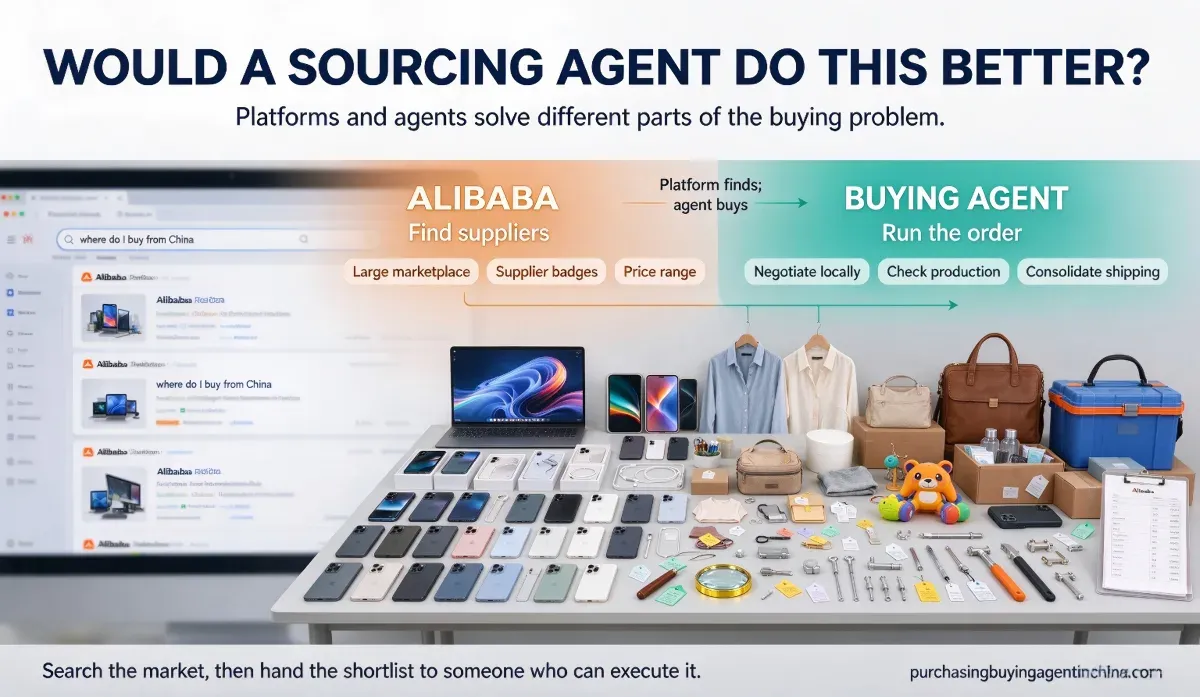
Put "where do I buy from China" into any search box and Alibaba is the first answer - the biggest marketplace, the most suppliers, the site your competitors already use. Then somewhere around the third supplier who stops replying mid-negotiation, a different question forms: would a sourcing agent do this better?
The honest answer is that they solve different parts of the problem. Here is where the platform's help actually ends.
What Alibaba does well
Alibaba is an intermediary: it gathers enormous numbers of suppliers behind one search box and gives you tools to sort them - verified badges, years listed, response rates, transaction history, a messaging system, and buyer-protection programs for the payment stage. As a way to find suppliers and see the market's range of products and prices, nothing beats an afternoon on it.
For a buyer who knows the product, knows the category, has time to manage the order - the platform plus its protections can be enough.
What the platform leaves with you
Everything after the search, which is to say the actual buying. The platform connects; you still run the deal. Translating your requirements and the supplier's replies. Judging which of five similar listings is a factory and which is a reseller with better photos. Negotiating in a market where the first price is a region, not a number. Chasing production. Flying - or not flying - to check goods before they ship. Consolidating when your order spans several suppliers, as it usually does.
The platform's protections cover the order you placed through its system. They do not attend your production, open your cartons, or notice that this batch's color drifted from the last one. Those jobs are yours.
How to Source Products from 1688: A Step-by-Step Guide for Overseas BuyersWhat an agent adds on top
A buying agent takes over the jobs the platform hands back. You send a product or a list; the agent shortlists from suppliers it can actually visit, negotiates in the local language, places and follows the order, checks the goods at a warehouse before they ship, consolidates multi-supplier orders and hands everything to a forwarder. The platform is still in the picture - agents source through the same marketplaces and beyond them - but you are no longer the one operating it.
The trade is straightforward: you exchange a slice of control for a large block of hours, local knowledge, and someone whose job is to catch problems before they are yours. What that help costs - and whether it runs as a flat fee or a commission - is a separate question, and worth asking before you commit, not after:
How Much Does a China Sourcing Agent Cost? Commission Models ExplainedChina Sourcing Services: What's Included (and What's Not)How to choose
The platform route fits you when: you enjoy the work, your order is a single straightforward product, you can verify the supplier yourself, and your calendar absorbs the follow-up.
An agent fits you when: the order spans several suppliers, the product needs samples judged in the hand, you cannot attend a warehouse check yourself, or your time is worth more than the booking clicks. If this is your first order from a new supplier, assume you are already in this list.
And the two are not rivals. Plenty of buyers search the platforms to learn the market, then hand the shortlist to an agent to run. The platform finds; the agent buys.
China Sourcing Agent: A Reliable Buying Agent in ChinaSend us your product list and compare the two routes on a real quote