Buying Guides
Guangzhou Sourcing Guide: Markets by Product Category
A dozen specialized clusters share one city. Which district trades your category, how the tiers inside it differ, and how a buying day actually runs.
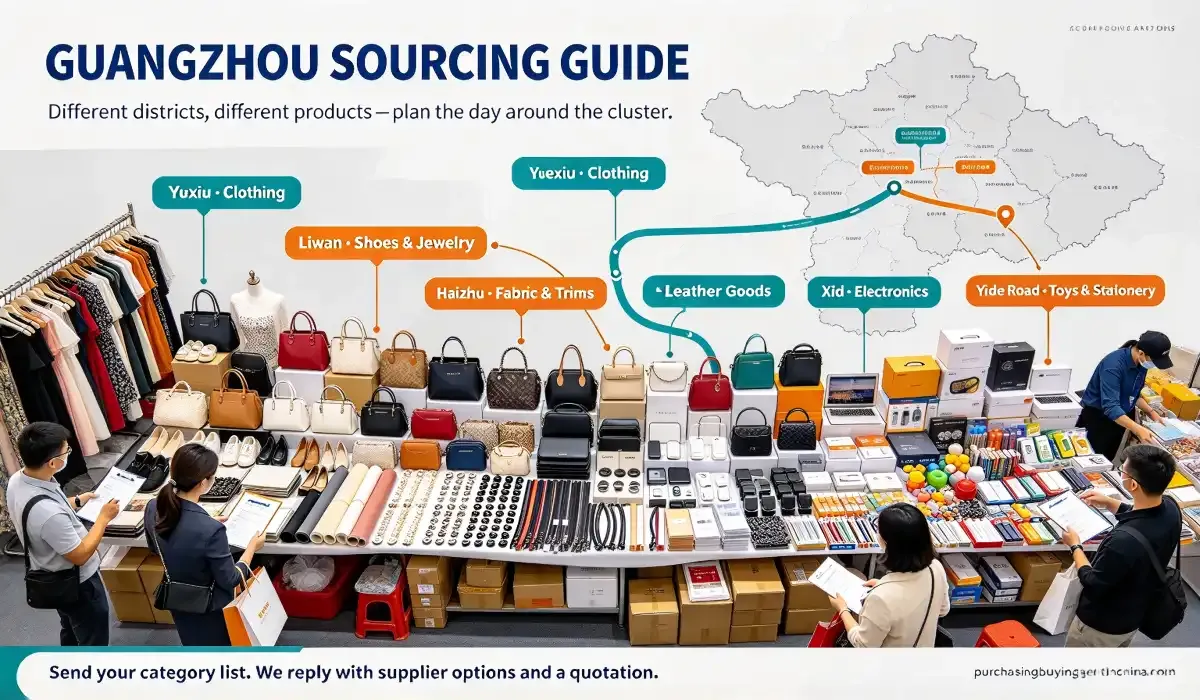
Ask what Guangzhou sells and the honest answer is: whichever district you are standing in. The city holds one of the largest concentrations of specialized wholesale trade anywhere, but it is organized as a dozen distinct clusters rather than one building, and the cluster decides the product. This guide maps the categories to their districts, explains how the tiers inside each one differ, and walks through how a buying day actually runs.
Which district trades which product
Clothing concentrates in Yuexiu district, from fast-fashion womenswear to higher-end showrooms. Shoes and jewelry cluster in Liwan around its plaza districts. Fabrics and trims own Haizhu, where dozens of specialized fabric markets sit within walking distance of one another. Leather goods belong to Sanyuanli and the Baiyun centers, with Huadu further out as a production base. Electronics and components trade around the Xidi malls.
Get the district right and the rest follows; get it wrong and you spend your day traveling between buildings that do not sell what you came for. Names and buildings also shift - markets renovate, relocate and rebrand - so verify the current layout on the ground or through someone who buys there weekly.
Clothing: the three tiers
Within the clothing cluster the tiers are distinct enough to plan around. The fast-fashion market at the top of the trend cycle does its serious trade in the morning and winds down by mid-afternoon; once a style is gone, reorders are often impossible. The mid-to-higher tier trades from showroom-style halls with more export buyers, higher prices and higher minimums. The volume tier moves basics and stock lots at the lowest prices, trading from before dawn to late morning; one style can carry three prices inside a single building - which is exactly why buyers work the tiers with a sample in hand instead of buying off the first rack.
Apparel wholesale starts early, peaks in the morning, and closes early afternoon; leather and fabric markets keep ordinary office hours. Plan the day around that clock.
Sourcing clothing from China: suppliers, fabrics, MOQsBeyond clothing: leather, fabric, electronics and the rest
Leather bags and goods cluster around Sanyuanli and the Baiyun centers, where genuine leather, split leather and coated fabrics sit side by side on shelves and look alike - a reason to buy leather with someone who can tell them apart. The fabric cluster around Zhongda holds cloth, linings, zippers, buttons and labels within walking distance, so a full sample - cloth, lining, trims, labels - can be assembled without leaving the cluster. Electronics around Xidi covers cables, chargers and small gadgets, with a second-hand and parts area nearby that is a trade for specialists rather than a starting point for importers.
Beauty and packaging have their own centers, jewelry sits near the Liwan plazas, and toys and stationery trade around Yide Road. Cosmetics deserve extra care on composition and labeling before price is even discussed.
How a buying day actually runs
The working sequence the markets reward: pick the district, work the tiers inside it, distinguish shelf stock from order-based production, then sample, specify and order. Sellers quote from objects, not from descriptions - arrive with a physical sample, a target specification and a quantity, and the same conversation lands on a real price. Quantities and repeat orders move prices more than haggling does, especially in the fast-fashion tier where margins are thinnest.
Goods bought across several markets should move to a warehouse as you buy rather than piling up in seller storage, so the whole day's purchasing can be checked and consolidated into one shipment.
Where Guangzhou is not the answer
Three categories belong elsewhere. Furniture and building materials belong to Foshan, about an hour away. Small mixed commodities - toys by the carton, household goods, seasonal stock - belong to Yiwu, where the breadth sits under one roof. And electronics at serious scale belong to Shenzhen, the technology hub an hour away; buyers commonly pair the two Pearl River Delta cities in one trip.
Shenzhen vs. Guangzhou vs. Yiwu: where to source whatSourcing Guangzhou through an agent
Remote buying through a China-side partner is standard practice in these markets: the partner visits the districts, collects quotes and photos, arranges samples, negotiates in the local language, and consolidates the purchases for export. From a Shenzhen base, the Guangzhou districts are about an hour away.
6688 Buying & Purchasing is that agent. Send your category list and the reply comes inside a day: supplier options and a quotation, laid out district by district. The commission is a 5-10% cut of the goods value - where it lands in that range follows the size of the order and how hard the category is to source. There is no minimum order, and goods are checked before the cartons seal.
How a buying agent works, step by stepGet a district-by-district sourcing plan