
Buying Guides
Sourcing Clothing from China: Suppliers, Fabrics, MOQs
The three questions behind most clothing orders from China: who supplies it, what it is made of, and how many pieces the trade really asks for. How agents answer each one.
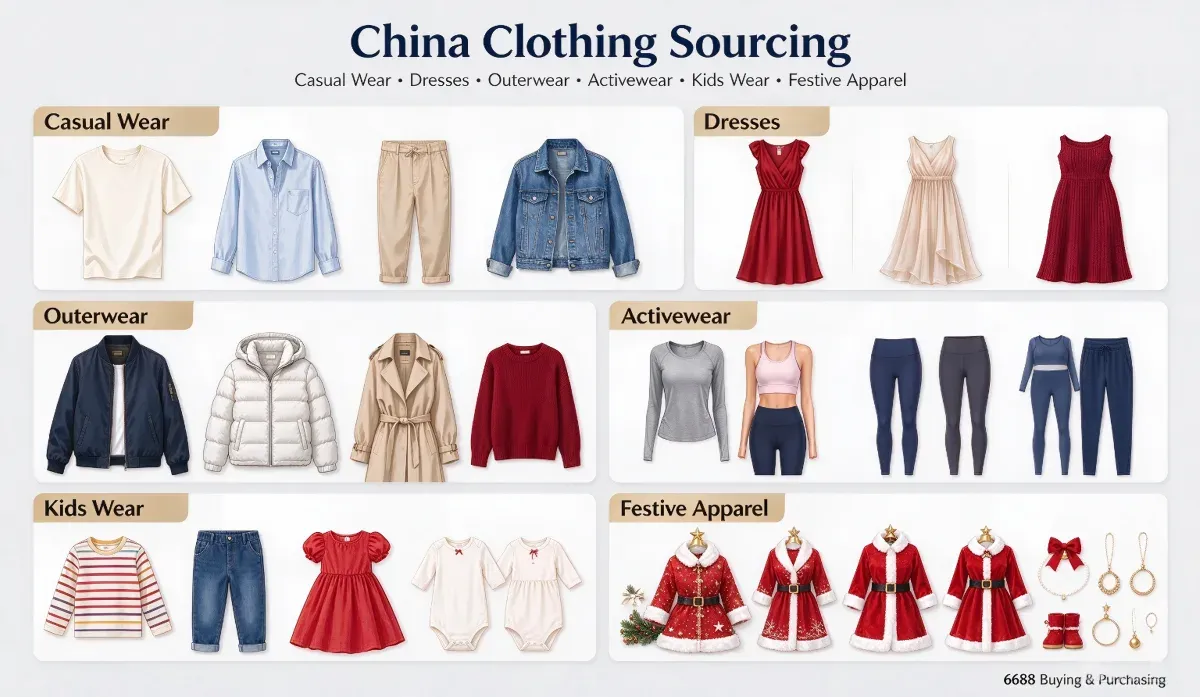
Clothing is where many first-time buyers start, and the questions tend to be the same three: who supplies it, what exactly is it made of, and how many pieces do I have to commit to. Get those three answered honestly and the rest of the order follows. This guide works through each one the way a buying agent does - with the platforms, the markets and the sample rack doing the talking.
Where clothing sourcing actually starts
Two channels carry most clothing sourcing: the international platforms and the domestic wholesale trade. The first, Alibaba above all, list clothing manufacturers, searchable in English, with ratings and reviews to filter by. 1688, the domestic wholesale platform, usually shows lower prices for the same categories of goods, but it is Chinese-language and set up for buyers inside China - which is why buyers who do not read Chinese go through an agent.
The physical channel sits alongside: wholesale clothing markets and stock-lot districts, where surplus and off-season goods trade in bulk and are sometimes priced by weight rather than per piece. For trend-driven buying, the markets are where new styles appear first; for repeat basics, the platforms and factories are the steadier route.
Agent vs. Alibaba: where each one fitsScreening suppliers before you fall in love with a price
The screening criteria that matter are behavioral, not decorative: sales volume on the listing, the review profile, the repurchase rate, refund rates, and how many years the supplier has been operating. A listing with strong numbers on those fronts tells you something a polished photo gallery cannot.
Experienced buyers shortlist two or three suppliers for the same style, ask each for a price at your quantity and order samples from each before tipping your hand on volume or commitment. Ask directly whether an item is original stock or produced to order - suppliers usually answer honestly when asked plainly.
Factories, trading companies, and what actually matters
Buyers burn a lot of time trying to classify suppliers as factories or trading companies. The pragmatic view, common among agents: judge the price, the product quality and the sample results, not the business-card category. A good trading company with a stable workshop behind it usually beats a difficult factory; a factory with no patience for small foreign orders can cost you a season.
What does matter is fit: a supplier set up for repeat production of your category, at your quantity, with communication that survives the details - size charts, color lots, stitching standards - rather than collapsing after the first message.
MOQs in practice
The fear of huge minimums is mostly out of date. Many suppliers on the platforms already support minimums around 50-100 pieces per style, and some allow orders of a handful of pieces for sampling or testing; stock-lot dealers often sell by weight or in mixed lots rather than per style. Factory production runs and fully custom styles sit higher - those minimums are set by the production line, not by policy.
Two caveats keep expectations honest: the quantity behind your inquiry moves the quoted price more than haggling does, so a thin order rarely sees the best number; and a listed minimum is frequently a default rather than a wall - negotiate with a real quantity and a real style in hand.
A buying agent for small orders: no-MOQ sourcing explainedFabrics and specs you cannot see on a screen
Clothing hides its quality in exactly the places a listing photo flattens: fabric composition and weight, shrinkage, color accuracy across a dye lot, stitching density, and the size chart's honesty. Retouched photos make color and material judgments unreliable, so ask for real-life photos of the actual goods - and treat the size chart as a claim to be verified on a sample, not a fact.
Samples are the whole game here: order paid samples from the shortlist, compare them side by side against your target spec, and remember the caveat every agent repeats - a good sample does not guarantee a good batch, so the trial order stays small and the first bulk order gets checked before it ships.
Running the order end to end
The sequence that works: shortlist, sample, compare, small trial, then scale with the supplier who held up - keeping a second source warm in case the first stumbles. An agent compresses the loop by speaking the sellers' language, negotiating at local level, consolidating samples and goods from several suppliers into one shipment, and checking the goods before they leave.
How a buying agent works, step by stepHow 6688 runs clothing orders
6688 Buying & Purchasing works clothing the way this guide describes: we answer within 24 hours with candidate suppliers for the styles you send, samples are ordered and compared before any bulk commitment, and nothing ships before it has been inspected with photos or video. You pay a commission of 5-10% of the goods value; where in that range it lands follows the size of the order and how much digging the sourcing needs. There is no minimum order, and shipping and payment fees are passed through at cost.
If you want to see the category through our own shop window first, our Christmas gifts, decorations and apparel sourcing page shows the range we cover.
Christmas gifts, decorations and apparel sourcingGet candidate suppliers for your styles